This post is part of an educational campaign by Blackfoot Confederacy Tribal Council—separating fiction from fact, correcting misinformation, and protecting Blackfoot and First Nations’ rights.

Fiction and Fact in Niitsitapi Territory

Final Statement of the Blackfoot Confederacy Educational Campaign

FICTION: The Metis Nation of Alberta can claim a Metis Homeland inside Niitsitapi Territory by negotiating directly with Canada and Alberta, treating this land as if it is neutral provincial property open for new political identities. Their maps and agreements imply that thousands of years of Blackfoot sovereignty can be replaced by modern recognition, as if our presence is just another story beside theirs.

FACT: Niitsitapi Territory is the sovereign land of the Blackfoot Confederacy whose law, identity, and creation rise directly out of this place since time beyond memory. Our sovereignty predates Canada and was never surrendered under Blackfoot Treaty 7, and no agreement between the MNA and the Crown can override the original authority of the Blackfoot people on our land.

Land acknowledgements have become a place where these truths are either honored or erased. When acknowledgements mix all Indigenous peoples together without specificity, they create a convenient fog that allows the Metis Nation of Alberta to position Niitsitapi Territory as part of their homeland, rather than the ancient and continuing territory of the Blackfoot Confederacy. They rely on general language and Crown recognition to present themselves as equal title holders, while ignoring the first nation of this land entirely. This is why their agreements with Canada and Alberta repeat the same fiction, offering land, rights, and jurisdiction inside our territory without ever speaking to the Blackfoot Confederacy that has lived here since time unmeasured.

The fact remains that Niitsitapi Territory is Blackfoot land. We are not newcomers or later arrivals who shaped an identity here. We are this land speaking. Our creation stories, our ceremonies, our teachings, and our laws come from this soil, from these rivers, from these plains, and from these hills. Blackfoot Treaty 7 affirmed our sovereignty, it did not remove it. Canada cannot give away what Canada never owned, and the Metis Nation of Alberta cannot claim authority in a place where Blackfoot law has stood since the beginning of our existence. No map, no agreement, and no government recognition can replace the truth of origin.

A true land acknowledgement must begin with the Blackfoot Confederacy, because this is Blackfoot land and always has been. It cannot place later arrivals above the first people of this place, and it cannot describe Niitsitapi Territory as a shared Metis homeland. Any acknowledgement that does this is incorrect. The MNA cannot build a homeland on top of ours, and they cannot sidestep the Blackfoot Confederacy to negotiate rights with the Crown. To First Nations facing the same struggle across these lands, we stand with you. To Metis citizens who reject the overreach of the MNA, we see your honesty. Our land, our law, and our sovereignty are not negotiable, not erasable, and not subject to agreements that ignore the original people of this place.
This post is part of an educational campaign by Blackfoot Confederacy Tribal Council—separating fiction from fact, correcting misinformation, and protecting Blackfoot and First Nations’ rights.

Week 4 – Fiction vs Fact: The Myth of a “Modern Treaty” and the Attempt to Reframe Blackfoot Treaty 7

Fiction:
A “modern-day treaty” of the Otipemisiwak Métis Government creates a nation-to-nation relationship equal to or parallel with Blackfoot Treaty 7, and positions the MNA as a treaty nation in Blackfoot Territory.

Fact:
The MNA describes a treaty as a “legally binding, nation-to-nation agreement that affirms rights, responsibilities, and relationships between the Crown and Indigenous nations.” That definition is correct — and it belongs to the First Nations who actually entered treaties with the Crown. The Niitsitapi fulfilled every part of that definition in 1877. The MNA did not.

The MNA claims their modern agreement will “chart a path forward to an enduring, nation-to-nation, government-to-government relationship with Canada through a modern-day treaty.” But this language only underscores the truth: Treaty 7 already created that relationship here — long before the MNA existed. The MNA’s attempt to adopt treaty language does not elevate their agreement; it exposes that their political project relies on attaching itself to the very treaties they were not part of.

The MNA also contrasts “historic” treaties with “modern-day” ones, framing Treaty 7 as an outdated land-transfer agreement while painting their own as progressive, rights-affirming, and more aligned with today’s legal landscape. But this narrative is misleading and disrespectful. Treaty 7 was not a land-transfer or land sale. It was a peace treaty with the Crown, created after years of warfare, starvation, smallpox, the collapse of the buffalo herds, and overwhelming pressure from colonial expansion. We entered Treaty 7 to protect our people — not because we misunderstood what we were signing, and not because we surrendered our homeland.

The MNA says their treaty will “affirm the rights of Indigenous peoples, not just recognize them.”
But Treaty 7 already affirms that: the Crown recognized Blackfoot sovereignty, laws, and territorial authority, and pledged peace in return. The MNA’s push to frame their modern agreement as a stronger, more legitimate form of treaty-making relies on diminishing ours — the very treaties that created the legal environment they are now trying to benefit from.

The MNA states their treaty will “ensure our self-government is protected regardless of changes in political power.” But First Nations already hold this protection under Treaty 7 and Section 35 — not because of new agreements, but because of our ancient relationship with these lands and the Crown. We do not need a modern adaptation of treaty principles to validate our sovereignty.

They also say their ancestors were “not included in the numbered treaties” and were instead part of the “broken scrip process.”
This is historically accurate — and it reinforces, not weakens, the truth:
Métis were not treaty signatories.
Métis were not rights-bearing Nations in Blackfoot Territory.
Métis were not partners in Blackfoot Treaty 7.

These admissions directly contradict today’s attempt to stand beside treaty nations as equals in the treaty-making process.

The MNA repeatedly emphasizes that their treaty is “not land or regionally-based,” yet they simultaneously assert province-wide harvesting rights and seek recognition across all of western Canada. This contradiction exposes the game: claim a “modern treaty” on paper, then use it politically to push into First Nations territories where there is no historical, legal, or kinship foundation.

And finally, the MNA notes that their treaty will be “binding on all governments and third parties.”
This includes First Nations — and that is precisely the danger.
A modern, province-wide “Métis treaty,” created without Blackfoot consent, attempts to place the MNA into the same constitutional space as the treaty nations whose sovereignty predates Canada itself. That is not reconciliation. That is political overreach.

We remind the Métis Nation of Alberta that they are descendants of First Peoples — and with that comes a responsibility to respect those who came before them, not rewrite our history to validate their political ambitions.

Blackfoot Treaty 7 is not “historic” in the sense the MNA frames it.
It is foundational. It is living. It is active.
And it will not be overshadowed by any modern political agreement designed to mimic its authority.

Solidarity and Respect

We are strengthened by many allies and by Métis organizations in southern Alberta who continue to speak the truth.

We thank our Elders, our knowledge keepers, our researchers, our community, and our allies who walk with us in truth and respect. Together we stand in unity and affirm what has never changed.

This is, and will always be, Niitsitapi Blackfoot Territory.

This post is part of an educational campaign by Blackfoot Confederacy Tribal Council—separating fiction from fact, correcting misinformation, and protecting Blackfoot and First Nations’ rights.

Week 3 | MÉTIS PRESENCE IN SOUTHERN ALBERTA & THE 1876 BLACKFOOT PETITION

Fiction: “Métis people have maintained a continuous and deep connection to southern Alberta prior to Blackfoot Treaty 7, and their presence reflects longstanding belonging and identity across this region.”

Fact: The Niitsitapi, the Blackfoot People, are the first First Nations of these territories. Niitsitapi governed, protected, and sustained this land long before any newcomers arrived.

When the Blackfoot Confederacy’s “traditional enemies” mostly made up of Cree, began moving into Blackfoot Territory in significant numbers in the mid to late 1800s, they did not come as guests or allies. They came as competitors, seeking to consolidate their own power on the plains at a time when everyone could see that the large scale settling of the West was taking shape.

For generations, Blackfoot Elders have passed down accounts of enemies entering without permission, travelling deep into the centre of Blackfoot hunting grounds, being chased out, and refusing to follow the laws of this territory. These groups later used the growing settler state as a shield to move further into what the Métis themselves described as “enemy territory,” because they knew they had no kinship ties or shared political relationships with the Blackfoot.

These are not stories of kin-making or shared belonging. They are stories of possessiveness, of outsiders acting entitled to Blackfoot lands and disregarding the sacred relationships Niitsitapi have with the territory.

The 1875–1876 Blackfoot Petition: A call to stop an invasion

In 1875, the Blackfoot Confederacy Grand Council drafted a petition, translated by Jean L’Hérueux, to the Crown. It described exactly what was happening:

“The Half-breeds and Cree Indians in large camps are hunting buffalo, both summer and Winter, in the very centre of our lands.”

– HBC Archives, Alexander Morris Fonds, P5284.8

Our chiefs documented these encroachments as early as 1875, and they remain part of the political memory of Blackfoot Treaty 7. Claims of a “continuous and deep connection” to southern Alberta erase the record that they were never invited to be in the territory in the first place.

A pattern that continues today

Blackfoot knowledge keepers have long observed these patterns in Métis encroachment, especially in trespassing into Blackfoot territory and hunting buffalo without our permission.

We might understand these acts as a kind of insatiable hunger, a drive to take land, resources, and power without regard for the laws of the people who belong to that place. Blackfoot stories warn us about this kind of behaviour, and we know our Cree neighbours hold similar teachings. In Cree ways of knowing, Wîhtikow describes a being with a consuming appetite that ignores relationships, boundaries, and responsibilities. This is the word some Cree use to name conduct that devours without care.

The Blackfoot see similar patterns in how the Métis Nation of Alberta Association (MNA) acts today, particularly in their efforts to claim all of Alberta and western Canada as their “traditional homeland.” This is not only historically inaccurate, it reflects a continued pattern of bad relations that echoes earlier behaviours our ancestors confronted in the nineteenth century. MNA political projects, including district boundaries, harvesting claims, IPCAs, and flag raisings, continue to move as though they are entitled to the territories of all Nations, including ours here in Southern Alberta. 

This is why the historical record matters. These are not new conflicts; they are the same patterns our ancestors called out when the Métis and our other enemies fought when they attempted to enter into Blackfoot Territory. These are not the stories of shared belonging. They are the stories of outsiders acting entitled to our homelands and ignoring Blackfoot law and responsibility.

They attempt to overwrite Blackfoot truth with a version of history that serves someone else’s narrative, not what actually happened on these lands.

The Truth:

Claims that the Metis Nation of Alberta had a “continuous and deep connection” to all of southern Alberta erase everything our ancestors lived, witnessed, and fought to protect. They ignore our political record. They disregard our laws. And they attempt to overwrite Blackfoot truth with a version of history that serves someone else’s narrative, not what actually happened on these lands.

As Niitsitapi, we have a responsibility to speak clearly: southern Alberta is Blackfoot Territory. It has always been Blackfoot Territory. Our people negotiated, petitioned, protected, and stood firm so that future generations, including us today, would still know whose land this is.

We will not allow our history to be rewritten, minimized, or replaced.

The truth remains what it has always been: this is, and will always be, Niitsitapi Blackfoot Territory.

This post launches a five-part educational campaign by Blackfoot Confederacy Tribal Council—separating fiction from fact, correcting misinformation, and protecting Blackfoot and First Nations’ rights.

Week 2 | MEtis Nation of Alberta (MNA) Harvesting rights in Blackfoot Territory

Fiction:

“The Metis Nation of Alberta have inherent harvesting rights covering every corner of our province including the south.” – Source: MNA website harvesting rights page


Fact:

The Blackfoot Confederacy has protected, governed, and harvested from this land for thousands of years. Southern Alberta is Blackfoot Territory. It was never the homeland of rights bearing Metis communities.

Throughout the 1800s our main rival on the plains were the Cree. When buffalo herds declined and moved deeper into our territory, conflict concentrated inside Blackfoot homelands. The 1870 Battle of Belly River in Sikoohkotok, present day Lethbridge, was a decisive Blackfoot victory and is recognized as the last large scale battle between First Nations on the northern plains.

United States based fur traders did not attempt to move into southern Alberta until the 1830s because of the strength of the Blackfoot Confederacy. When the Hudsons Bay Company built Old Bow Fort, also called the Peigan Post, in 1832 to pull Blackfoot trade away from American traders, it was abandoned within two years. It provided few furs and required many men because of the danger of operating inside Blackfoot Territory. After it was abandoned, the Blackfoot burned it down.

From 1800 to 1859, Hudsons Bay Company Governor George Simpson marked southern Alberta as “terra incognita,” meaning unknown land. It was unknown to them because they could not safely enter it. The Blackfoot Confederacy maintained undisputed control over this land until the 1880s.

Niitsitapi do not have a word for “Metis.” Settler record keepers often used their own words like “half breed,” but our ancestors followed kinship law. If a child was born into our families, they were Niitsitapi. They were our own.

Our Elders tell stories about early encounters when settler hunting parties and Northwest Mounted Police entered without permission. Blackfoot warriors counted coup on them and took their Hudsons Bay capotes as a warning. It reminded newcomers that Blackfoot Territory requires respect and consent.

The Truth: Modern courts have confirmed what Blackfoot knowledge keepers have always said. The 2011 Hirsekorn decision found that there are no historic rights bearing Metis communities in southern Alberta. Because of this, there are no constitutionally protected Metis harvesting rights inside Blackfoot Territory.

Metis harvesting rights recognized by Alberta apply only in areas in northern Alberta where historic Metis communities were proven to exist. No such communities existed in the Blackfoot Treaty 7 area of the Siksika, Kainai, Piikani, or Aamskaapipikani.

No modern organization can claim historic rights here when the history shows clearly that this territory was Blackfoot controlled, Blackfoot governed, and Blackfoot defended. This is Blackfoot Territory.

Solidarity and Respect: We are strengthened by many allies and by Metis organizations in southern Alberta who continue to speak the truth.

The Lethbridge and Area Metis Association recently stated that the MNA does not represent them. They reaffirmed their respect for Treaty 7 Territory and recognized the Blackfoot Confederacy as the traditional land keepers of this region. They also acknowledged that Metis families historically moved across the prairies but that these lands remain the homelands of the Blackfoot Confederacy.

We thank our Elders, our knowledge keepers, our researchers, our community, and our allies who continue to walk with us in truth and respect. Together we stand in unity and affirm what has never changed. This is and will always be Niitsitapi Blackfoot Territory.

The Siksikaitsitapi Ohkin’ninaiiks (Blackfoot Confederacy Chiefs), representing the Kainai Blood Tribe, Piikani, Siksika, and Aamsskaapipikani Nations, stands firm in protecting Blackfoot Territory and the sovereignty of our Nations. The Chiefs are calling on the Governments of Canada and Alberta to stop supporting Métis-led initiatives taking place within our lands, the Blackfoot Treaty Territory.

Our Nations have always protected and cared for this land, and we continue to do so today. The Chiefs say recent actions by Métis Associations, including Indigenous Protected and Conserved Areas (IPCAs), flag raisings, and naming projects, are being used to create the appearance of rights and authority within Blackfoot Territory. These actions disregard the R. v. Hirsekorn decision, which confirmed there were no historic Métis communities in southern Alberta and no harvesting rights or Aboriginal title here.

The Blackfoot Confederacy is calling for an immediate suspension of these Métis-led activities and for governments to recognize the Blackfoot as the original and rightful stewards of this land. True reconciliation begins with respecting Blackfoot law, governance, and consent, not through policies that erase or sidestep our authority.

Our Chiefs reaffirm that the Blackfoot people have never given up our responsibility to protect Niitsitapi Territory. We invite all who understand and respect this truth to stand with us as we continue to defend our lands and uphold the strength and dignity of the Blackfoot Confederacy.


Read the full statement here:

Cassie Ayoungman joins Blackfoot Confederacy as Destination Blackfoot Promotion Coordinator
Blackfoot Confederacy Tribal Council is proud to announce the appointment of Cassie Ayoungman as Destination Blackfoot Promotion Coordinator. Cassie is a member of Siksika Nation and has been one of the featured operators within Destination Blackfoot through her organization Soul Of Miistaki, an Indigenous led initiative that shares land based experiences rooted in Blackfoot knowledge.


Cassie is a proud Siksika’ki (Blackfoot woman) raised on Siksika Nation Alberta. Basketball was a big part of her upbringing and remains close to her heart. She later participated in the Indigenous military Bold Eagle program before discovering mountain sports in her mid twenties. Cassie quickly recognized the lack of diversity in outdoor spaces and was inspired to create Soul of Miistaki, a not for profit that brings people together through hiking climbing biking and skiing while incorporating Indigenous cultural practices and teachings.


Climbing has been both a teacher and healer for Cassie offering lessons in resilience and personal growth. She continues to give back to her Nation as a practicing paramedic and through her work as an Arc’teryx Alberta Ambassador, advancing representation and awareness for Indigenous presence in outdoor communities.


In her new role with Destination Blackfoot Cassie will help elevate operators across the Confederacy, strengthen partnerships, and showcase the growing network of tourism experiences rooted in Siksikaitsitapi culture. Her leadership will ensure that the promotion of Blackfoot tourism remains guided by community values and continues to benefit our Nations.


We are excited to welcome Cassie to this new position. Look out for updates on Destination Blackfoot in the coming weeks, including operator spotlights, new visitor resources, and Confederacy wide initiatives that will highlight our people and our lands.


📷: from Cassie Ayoungman | Soul of Miistaki Website

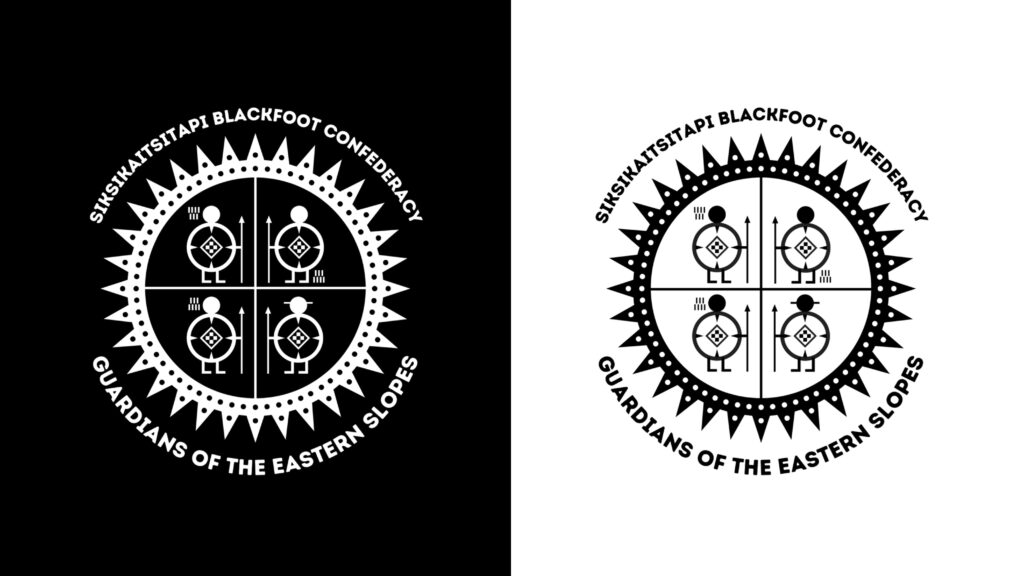
New Logo for the Siksikaitsitapi Blackfoot Confederacy Guardians of the Eastern Slopes

The Blackfoot Confederacy Tribal Council announces the official logo for the Siksikaitsitapi Blackfoot Confederacy Guardians of the Eastern Slopes of the Rocky Mountains, designed by Rudy Black Plume from Kainai–Blood Tribe.

This logo represents the longstanding role of Niitsitapiiksi in managing and protecting the Prairie and Rocky Mountain ecosystems. For generations, Blackfoot people have applied cultural knowledge to maintain balance on the land through fire stewardship, water management, sustainable harvesting, rotational farming, agroforestry, and the preservation of sacred sites.

The design elements draw directly from Blackfoot culture:

• Triangles- represent the Rocky Mountains and are a shared Blackfoot painted lodge design linked to teachings about honouring and protecting children, and land stewardship for future generations.

• Four Shielded Warriors: based on pictographs from Aisinapi (Writing-on-Stone), each represents one of the four tribes within the Confederacy and the collective responsibility to protect both prairie and mountain environments.

• Whirlpool Shield Design: signifies the importance of safeguarding the Eastern Slopes watershed.

This logo stands as a statement of the Blackfoot Confederacy’s responsibility and authority in protecting lands and waters of the Eastern slopes of the Rocky Mountains.

Artist: Rudy Black Plume, Kainai–Blood Tribe

Program: Blackfoot Confederacy Guardians of the Eastern Slopes

Parks Canada and the Blackfoot Confederacy Tribal Council are pleased to launch the Blackfoot Guardianship of the Eastern Slopes of the Rockies project. This program will be Siksikaitsitapi-led, with support from Parks Canada staff in Waterton Lakes National Park (Paahtómahksikimi).


Since 2017, Guardians initiatives have supported Indigenous rights and responsibilities in protecting and conserving ecosystems, developing and maintaining sustainable economies, and continuing the profound connections between natural landscapes and Indigenous cultures. This program is the first of its kind in Southern Alberta. It will place dedicated Blackfoot Guardians on the ground to monitor, protect, and preserve sacred lands.

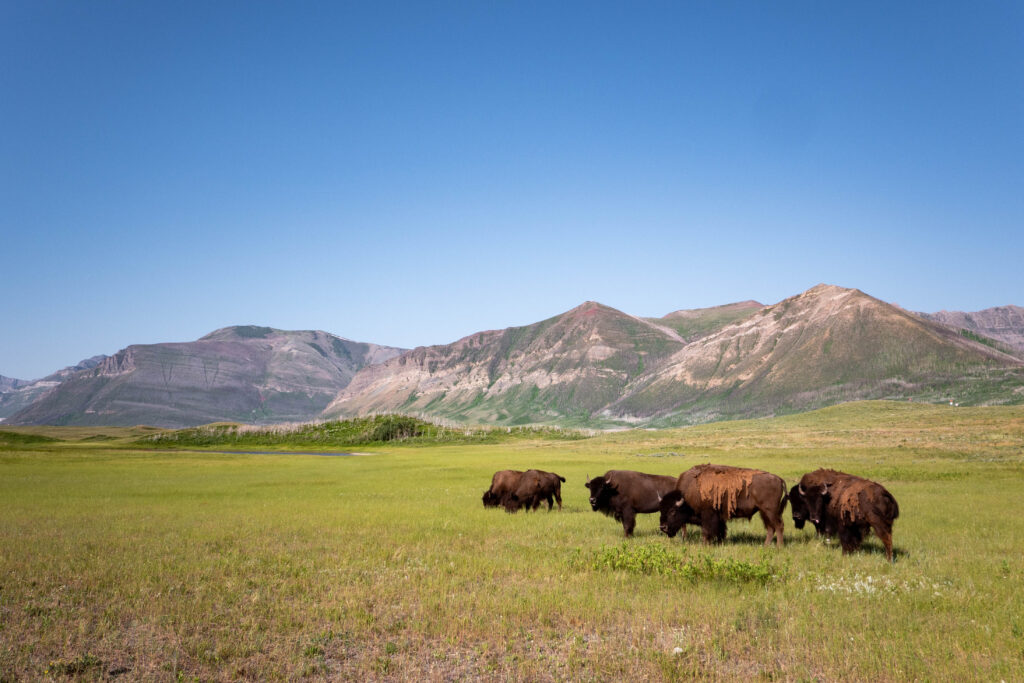
Bison Paddock – Waterton Lakes National Park – Photo Courtesy of Parks Canada

“As stewards of these ancestral lands, the Blackfoot Confederacy takes great pride in this opportunity to ensure the continued health and vitality of our environment. This project is not only a commitment to preserving the natural beauty and cultural heritage of the Blackfoot territory but also a testament to the strength and resilience of the Blackfoot people. We look forward to a future where our lands thrive, protected by the watchful eyes of our guardians, for generations to come.”


Jack Royal, Chief Executive Officer
Blackfoot Confederacy Tribal Council


“Blackfoot Peoples have been stewards of the lands and waters in this region since time immemorial. The Blackfoot Confederacy Eastern Slopes Guardian program will offer solutions on climate change and biodiversity loss while safeguarding the natural spaces we all depend on. Parks Canada is pleased to support this initiative both in and around Waterton Lakes National Park.”

Ron Hallman, President and Chief Executive Officer
Parks Canada Agency

Contacts:

Theoren Royal
Communications Officer
Blackfoot Confederacy Tribal Council
theorenr@blackfootconfederacy.ca

Matthew Nodge
Partnering, Engagement and Communications Officer
Parks Canada, Waterton Lakes Field Unit
matthew.nodge@pc.gc.ca