
This post is part of an educational campaign by Blackfoot Confederacy Tribal Council—separating fiction from fact, correcting misinformation, and protecting Blackfoot and First Nations’ rights.

Fiction and Fact in Niitsitapi Territory

Final Statement of the Blackfoot Confederacy Educational Campaign

FICTION: The Metis Nation of Alberta can claim a Metis Homeland inside Niitsitapi Territory by negotiating directly with Canada and Alberta, treating this land as if it is neutral provincial property open for new political identities. Their maps and agreements imply that thousands of years of Blackfoot sovereignty can be replaced by modern recognition, as if our presence is just another story beside theirs.

FACT: Niitsitapi Territory is the sovereign land of the Blackfoot Confederacy whose law, identity, and creation rise directly out of this place since time beyond memory. Our sovereignty predates Canada and was never surrendered under Blackfoot Treaty 7, and no agreement between the MNA and the Crown can override the original authority of the Blackfoot people on our land.

Land acknowledgements have become a place where these truths are either honored or erased. When acknowledgements mix all Indigenous peoples together without specificity, they create a convenient fog that allows the Metis Nation of Alberta to position Niitsitapi Territory as part of their homeland, rather than the ancient and continuing territory of the Blackfoot Confederacy. They rely on general language and Crown recognition to present themselves as equal title holders, while ignoring the first nation of this land entirely. This is why their agreements with Canada and Alberta repeat the same fiction, offering land, rights, and jurisdiction inside our territory without ever speaking to the Blackfoot Confederacy that has lived here since time unmeasured.

The fact remains that Niitsitapi Territory is Blackfoot land. We are not newcomers or later arrivals who shaped an identity here. We are this land speaking. Our creation stories, our ceremonies, our teachings, and our laws come from this soil, from these rivers, from these plains, and from these hills. Blackfoot Treaty 7 affirmed our sovereignty, it did not remove it. Canada cannot give away what Canada never owned, and the Metis Nation of Alberta cannot claim authority in a place where Blackfoot law has stood since the beginning of our existence. No map, no agreement, and no government recognition can replace the truth of origin.

A true land acknowledgement must begin with the Blackfoot Confederacy, because this is Blackfoot land and always has been. It cannot place later arrivals above the first people of this place, and it cannot describe Niitsitapi Territory as a shared Metis homeland. Any acknowledgement that does this is incorrect. The MNA cannot build a homeland on top of ours, and they cannot sidestep the Blackfoot Confederacy to negotiate rights with the Crown. To First Nations facing the same struggle across these lands, we stand with you. To Metis citizens who reject the overreach of the MNA, we see your honesty. Our land, our law, and our sovereignty are not negotiable, not erasable, and not subject to agreements that ignore the original people of this place.
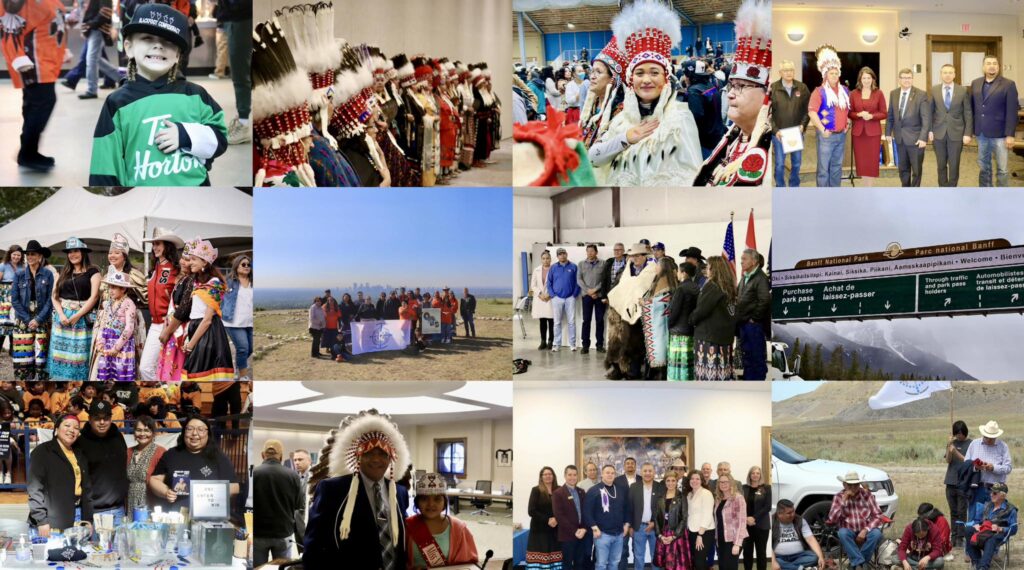
This post launches a five-part educational campaign by Blackfoot Confederacy Tribal Council—separating fiction from fact, correcting misinformation, and protecting Blackfoot and First Nations’ rights.

Week 1 — Districts and the Battle River Narrative


Fiction:

The size and boundaries of the “Métis Nation Homeland” can be determined by the Métis Nation of Alberta’s modern-day district assertions—such as Battle River, Calgary Elbow, and Calgary Nose Hill—without reference to historical facts or pre-existing Blackfoot occupation of these lands.

Fact:

Aboriginal and Treaty rights, and Resources are about land—its use, governance, and memory.
Being Indigenous to a place is not the same as being Indigenous in a place.

In 2023, the Métis Nation of Alberta District Boundaries Act created new provincial districts with zero consultation with the Blackfoot Nations, Chiefs, or the Confederacy Elders and Knowledge Keepers—in areas that have always been Blackfoot Territory.

The Battle River, Elbow, and Ootssapi’tomowa (Nose Hill) lie within or beside the homelands of the Siksikaitsitapi—Siksika, Kainai, Aamsskáápipikani, and Aapátohsipikani—who have governed, hunted, and held ceremony here since time immemorial.

The Battle River and Wetaskiwin:

The Battle River was named for early conflicts between the Cree and Blackfoot.
Peace followed and was commemorated at Wetaskiwin—from wîtaskîwinihk, “the hills where peace was made.”
That peace affirmed boundaries and respect, not shared jurisdiction.

Blackfoot Placemaking and Living Presence:

  • Mohkinstsis (Elbow) — the meeting of the Bow and Elbow Rivers, a Blackfoot governance and trading site for millennia.
  • Ootssapi’tomowa (Nose Hill) — a sacred high point, observatory, and renewal-ceremony site. Hundreds of tipi rings, cairns, and buffalo kill sites mark continuous Blackfoot occupation. At its summit stands the Siksikaitsitapi Medicine Wheel (2015), a visible affirmation that Blackfoot sovereignty and ceremony endure today. The structure is a Siksikaitsitapi landmark, following our tradition of leaving a marker wherever we travel within our homeland. Designer Andy chose symbols that tie us to our roots, traditions, values, worldview, and territory—understanding the importance of placing landmarks within Siksikaitsitapi territory to reinforce our kinship with the land and to signal to others that these are the lands of the Blackfoot Confederacy.
  • Okotoks (Rock) — from o’kotok, “rock.” A teaching site in Napi stories about respect and responsibility.

Blackfoot Names Define the Land:

Mohkinstsis (Elbow) | Ootssapi’tomowa (Nose Hill) | Okotoks (Rock) | Ponoka (Elk)

Each name anchors diplomacy, language, and stewardship that predate any provincial boundary or 2023 map.

The Truth:

In 2023, the MNA’s district system attempted to overlay a new narrative on Blackfoot land. These boundaries do not reflect historical presence, governance, or Nationhood. They are administrative creations—not truths of place.

A newly recognized provincial group that believes it has some Indigenous ancestry cannot declare a Nation into existence where one never was, nor redefine lands that already hold their own Treaty and sovereignty.

It has always been Blackfoot Territory.

A Message of Gratitude:

Blackfoot Confederacy Tribal Council thanks all allies, knowledge keepers, and community members who continue to stand with us in truth and unity.

We are strengthened by the support of First Peoples across these lands and beyond, and we acknowledge the many Nations and Métis citizens who have spoken out against the MNA’s actions and stood in solidarity with the Blackfoot Confederacy.

Together, we uphold the truth that has never changed
this is, and will always be, Niitsitapi Blackfoot Territory.

The Blackfoot Confederacy is pleased to announce that Iikaiksimatsa’pao’p (Grateful to Be on the Land) has been officially selected for the Banff Mountain Film Festival. A special screening and Q and A will take place on November 2 at 4:30 PM, with a second screening on November 9. Community members in the Bow Valley during BMFF are invited to attend and support this important work.


The short film, released by Arc’teryx, features Cassie Ayoungman, founder of Soul of Miistaki and a proud member of the Blackfoot Confederacy from Siksika Nation. Filmed by Trevor Solway of Siksika Nation, the story follows her healing through climbing and the incorporation of Indigenous teachings into land based learning. The film highlights ongoing efforts to break down barriers and create space for Indigenous participation in outdoor culture.


The Blackfoot Confederacy recognizes Cassie’s leadership as an operator within Destination Blackfoot, and welcomes her in her new role as Destination Blackfoot Coordinator. Soul of Miistaki continues to support community through cultural connection, strength, and revitalization on the land.


A sincere thank you is extended to all who contributed to the success of this project, including filmmaker Trevor Solway, for his continued work in amplifying Blackfoot stories.


Screening information:
https://filmfest.banffcentre.ca/schedule/special-film-screening-iikaiksimatsa-pao-p-68d75a9e525a69d354e3a554

On 15 May 2025 in Mohkinstsis (Calgary, AB), Chief Troy Knowlton released a detailed rebuttal to Premier Danielle Smith’s 13 May letter. Speaking for the Blackfoot Confederacy, he argues that the Premier’s remarks circulate disinformation that obscures the intent and legal force of the Blackfoot Treaty (Treaty 7, 1877) and related Crown‑Indigenous agreements.

Knowlton distinguishes between misinformation—unintentional error—and disinformation—strategic falsehood—and warns that blurring the two weakens public understanding of Treaty rights. Such distortion, he contends, damages provincial‑First‑Nation relations and erodes Alberta’s wider governance framework.

The Premier’s proposal to escort a selectively chosen group of Treaty Chiefs to Ottawa is described as a divide‑and‑conquer tactic. Chiefs Ouray Crowfoot (Siksika) and Travis Plaited Hair (Kainai) agree that the trip offers no tangible benefit to Blackfoot citizens and risks fragmenting pan‑Treaty solidarity. On that basis, the Confederacy declines to participate.

Turning to policy, the Chiefs reiterate their opposition to Bill 54 (Citizen‑Led Referendum Act), stating that the legislation would undermine the constitutional doctrine of Treaty supremacy by subjecting Crown obligations to majoritarian vote, inject policy volatility that could deter long‑term investment, and signal a retreat from Alberta’s fiduciary duties toward First Nations.

Knowlton also rejects the “Go Along Chief” label and observes that separatist rhetoric has only strengthened First‑Nation unity nationwide. The Confederacy emphasizes that it recognizes no office of “Grand Chief,” and that decision‑making authority is shared equally by the Chiefs of Siksika, Kainai, and Piikani; all government correspondence must therefore be addressed to all three leaders.

The statement urges Albertans—particularly scholars, media professionals, and civil‑society actors—to consult peer‑reviewed research and primary Treaty documents so that policy dialogue is grounded in evidence and authentic First‑Nation perspectives.

The Chiefs acknowledge the intellectual labour and steadfast advocacy of Blackfoot citizens, neighbouring Indigenous Nations, and allies across Canada. Their collective efforts, they affirm, advance the full implementation of the Treaties and the realization of Indigenous sovereignty.

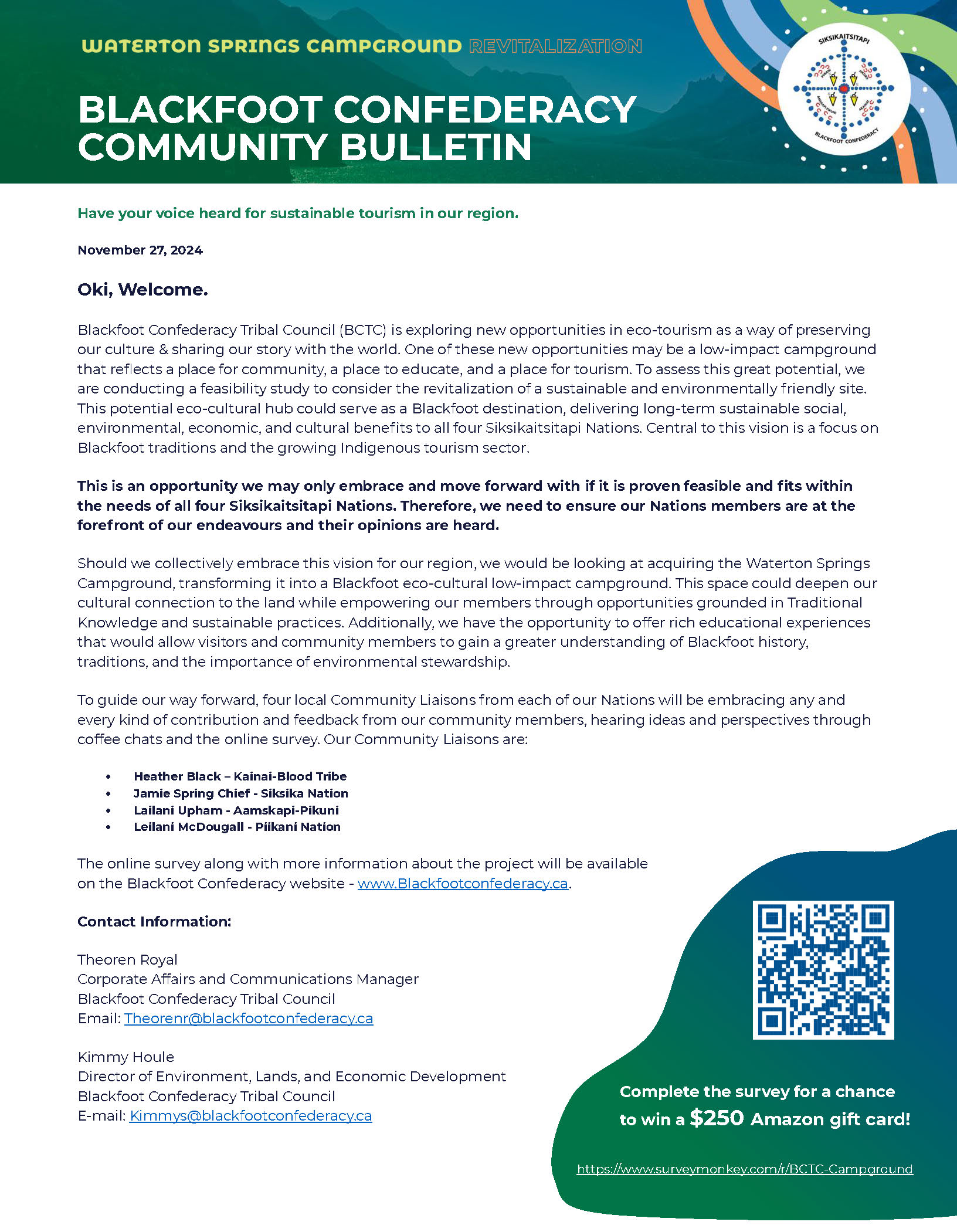
The Blackfoot Confederacy, through the Blackfoot Confederacy Tribal Council (BCTC), is launching a comprehensive feasibility study to explore the potential transformation of Waterton Springs Campground into a premier Blackfoot eco-cultural destination. This initiative underscores the Confederacy’s ongoing commitment to preserving the land while offering enriched cultural experiences for both community members and visitors. The project is designed to deliver sustainable long-term benefits- social, environmental, economic, and cultural, to all four Blackfoot nations, with a particular focus on Blackfoot traditions and the expanding Indigenous Tourism sector.

Active engagement with Confederacy members is crucial to the success of this initiative. By gathering insights and feedback, BCTC ensures that the project reflects the collective goals, knowledge, and values of the four nations. The feasibility study serves as the foundation for evaluating the potential for ownership and revitalization of the campground.

At this preliminary stage the project remains conceptual, and no final decisions have been made regarding development plans or timelines.

To guide our way forward, four local Community Liaisons from each of our Nations will be embracing any and every kind of contribution and feedback from our community members, hearing ideas and perspectives through coffee chats and the online survey.

Our Community Liaisons are:

  • Heather Black – Kainai-Blood Tribe
  • Jamie Spring Chief – Siksika Nation
  • Lailani Upham – Aamskapi-Pikuni
  • Leilani McDougall – Piikani Nation

An online survey has also been developed to ensure broad participation and engagement within the community. Members are strongly encouraged to contribute their ideas and perspectives by completing the survey or participating in interviews. This will ensure that the recommendations align with the collective vision and priorities of the Siksikaitsitapi Nations.

If you are a community member in the region, you can become involved by sharing your insights via a brief survey which can be found here: https://www.surveymonkey.com/r/BCTC-Campground


Contact and Media:

Theoren Royal,
Corporate Affairs and Communications Manager
Blackfoot Confederacy Tribal Council
Email: Theorenr@blackfootconfederacy.ca


Kimmy Houle,
Director of Environment, Lands, and Economic Development
Blackfoot Confederacy Tribal Council
E-mail: Kimmys@blackfootconfederacy.ca

To members of the Blackfoot Confederacy,

It has been my greatest honour to lead an organization built on the wisdom, unity, and resilience of the Blackfoot People. Today I am announcing my departure as the Founding Chief Executive Officer of the Blackfoot Confederacy Tribal Council and the Siksikaitsitapi Oh’Kininaiiks (Blackfoot Confederacy Chiefs) Society.

Over the past seven years it has been a privilege to build the Blackfoot Confederacy, and I am deeply grateful for the trust you placed in me to guide this important work. From our first steps, we built an organization rooted in our Siksikaitsitapi Culture and way of life, with staff representing each of the Blackfoot Nations as leaders, experts, and changemakers. I am proud of our team and the work we’ve done to honour our traditions and fulfill our vision as a united people, advocating for the protection of our Treaty and inherent rights.

Together we have strengthened our foundation with significant milestones: the signing of key Memoranda of Understanding (MOUs) that have strengthened our presence in the political, economic, educational, cultural, and social spheres across Canada and the United States. Throughout my time, the Blackfoot Confederacy has proudly served as an ambassador for collaboration among the Blackfoot Nations, bridging gaps and revitalizing our traditional ways. From establishing the Siksikaitsitapi Oh’Kininaiiks Society to actively engaging with governmental leaders, the Blackfoot Confederacy has been a unifying force determined to support and improve the well-being of our Blackfoot communities.

As I step forward onto a new path, I leave with immense pride in what we have achieved as a unified Blackfoot Confederacy. I am confident that the Blackfoot Confederacy will continue to grow, strengthening our sovereignty and enriching the lives of our people throughout Blackfoot Territory.

I want to express my heartfelt gratitude to all members of the Blackfoot Confederacy for your support. It has been my honour to lead the Blackfoot Confederacy to this point and I leave knowing that we have made a lasting impact. I hope you take as much pride in our shared achievements as I do.  We serve the Creator, who places us where we are meant to be, and I am thankful for this journey to serve the Blackfoot People. 

ISSKOOKITSMAH

Jack Royal