
Blackfoot Confederacy Third Annual Justice Symposium
“INNAIHTSIIYI” – Our Sacred Treaties

Dates: April 21–22, 2026
Location: Coast Lethbridge Hotel and Conference Centre


Event Overview

The Blackfoot Confederacy Third Annual Justice Symposium brings together leadership, Elders, justice professionals, community representatives, and youth from across the four Nations of the Blackfoot Confederacy to discuss justice systems through the framework of Blackfoot law, Treaty responsibilities, and community-based approaches to justice.

The 2026 symposium theme, “INNAIHTSIIYI – Our Sacred Treaties,” focuses on the responsibilities, obligations, and relationships established through Treaty agreements and how those commitments continue to influence justice governance, community safety, and legal systems affecting Blackfoot people today.

The two-day gathering will feature presentations from Blackfoot leadership, Elders panels, legal professionals, justice practitioners, and representatives from community justice programs across the Confederacy. Discussions will address Treaty perspectives on justice, Indigenous participation in the legal profession, community-led justice initiatives, policing governance, victim services, and federal corrections processes.

Participants will also have the opportunity to engage in networking and dialogue with justice leaders and community representatives from across the region.

An evening banquet and youth showcase will be held on the first day of the symposium, highlighting and recognizing Blackfoot youth through a cultural program and mini powwow.


Registration Information

Registration for the Blackfoot Confederacy Third Annual Justice Symposium is $150.00 per participant.

All participants must register through the Eventbrite registration link here: https://2026BFCJusticeSymposium.eventbrite.ca

Registration Deadline: April 10, 2026.

Registration includes:

  • Participation in all symposium sessions
  • Breakfast and lunch on both days
  • Evening banquet and youth showcase on Day One
  • Opportunities to connect with Blackfoot leadership, legal professionals, and justice practitioners

Cancellation Policy

Participants who are unable to attend must submit cancellation notice prior to April 10, 2026.

Registrations that have been paid but cancelled after the registration deadline will not be eligible for refund and will be considered forfeited. This policy ensures accurate meal counts, seating arrangements, and event planning commitments with the venue.


Symposium Highlights

  • Opening remarks from leadership representing the four Nations of the Blackfoot Confederacy
  • Elders panel featuring respected knowledge holders sharing perspectives on Treaty responsibilities and justice
  • Keynote address by Karen Crowshoe of the Alberta Court of Justice
  • Panel discussion examining the Alberta Sovereignty Initiative
  • Community justice presentations from each of the four Blackfoot Nations
  • Panel featuring Blackfoot lawyers discussing pathways and careers in law
  • Presentations from victim services organizations and justice governance bodies
  • Youth showcase and cultural program during the evening banquet

Day One – Tuesday, April 21, 2026

The symposium begins with breakfast and registration followed by an opening prayer and formal call to order. Opening remarks will be delivered by leadership representing the four Nations of the Blackfoot Confederacy, including Chiefs and executive leadership.

A Blackfoot Confederacy Elders panel will follow, featuring Leonard Weasel Traveler, Herman Yellow Old Woman, John Murray, and Wilton Goodstriker. The panel will provide perspectives on Blackfoot law, Treaty relationships, and community responsibilities.

The morning keynote address will be delivered by Justice Karen Crowshoe of the Alberta Court of Justice.

Afternoon sessions include a discussion on the Alberta Sovereignty Initiative facilitated by Eugene Creighton KC with participation from Paul Reid, JD of Walsh LLP. Community justice presentations will also be delivered by representatives from Blood Tribe and Piikani Nation.

A panel discussion titled “A Career in Law” will feature Blackfoot lawyers Eugene Creighton KC, Darnell Tailfeathers JD, Andrea Yellowhorn JD, and Dustin Fox JD, IJD, discussing professional pathways within the legal field.

The first day concludes with closing remarks and door prize draws.

An evening banquet will take place in the main ballroom beginning at 5:30 pm. The banquet includes a grand entry and opening prayer by Wilton Goodstriker, buffet dinner service, and a youth showcase honouring young people through a mini powwow.


Day Two – Wednesday, April 22, 2026

The second day begins with breakfast followed by opening prayer and recap of the previous day’s discussions.

Morning sessions will include a community justice presentation from Siksika Nation and a panel discussion featuring representatives from victim services organizations including the Southern Alberta Regional Victim Serving Society and Blood Tribe Victim Services.

A presentation will also be delivered by Teddy Many Wounds, Chairman of the First Nations Police Governance Council, addressing governance frameworks for First Nations policing.

Additional sessions include a community justice presentation from Amskapi Piikani Nation and a Blackfoot Confederacy consultation panel featuring representatives from Kainai, Siksika, and Piikani.

The afternoon will include a presentation on Section 84 processes within Correctional Service Canada followed by participant evaluation forms, questions, and open discussion.

The symposium concludes with final remarks and a closing door prize draw.


Venue

Coast Lethbridge Hotel and Conference Centre


Note:
The symposium agenda is subject to change. Adjustments to session times, speakers, or presentations may occur as required.

Registration: https://2026BFCJusticeSymposium.eventbrite.ca
Issue 002 of OKI COLLECTIVE captures a season of strong leadership, advocacy, and progress across the Blackfoot Confederacy. Highlights include the 24th Annual Blackfoot Confederacy Conference in Sikóóhkotok, national representation at the Alberta Recovery Summit, and the Blackfoot naming of the Thunder Medicine Pipe Bridge in Banff, each reinforcing Nation to Nation relationships and Blackfoot presence across territory. This issue also documents key governance milestones, including a court decision from the Alberta Court of King’s Bench affirming Treaty protections, alongside unified Chiefs’ responses and a five part educational campaign addressing claims by the Métis Nation of Alberta, reaffirming that Blackfoot law, consent, and sovereignty remain non negotiable.

The Confederacy also advanced major priorities in health, knowledge preservation, and economic development. Elders shared teachings on historic Blackfoot trade routes, strengthening intergenerational learning, while the Health team deepened partnerships across provincial, federal, academic, and community systems and welcomed new staff to support wellness priorities. Economic updates highlighted progress on the Waterton Springs Campground revitalization, employment planning, and tourism development through Destination Blackfoot, including completion of a new brand identity, an upcoming website launch in Q1 2026, early 2026 social media rollout, and international exposure through Condé Nast.

Issue 002 also celebrates community connection, from the Blackfoot Confederacy Golf Tournament supporting Siksikaitsitapi youth, to honoring outgoing Siksika leadership and welcoming new team members. Together, these stories reflect a Confederacy moving forward with clarity and purpose, protecting Treaty rights, strengthening relationships, investing in future generations, and advancing Blackfoot led systems rooted in Niitsitapi ways of knowing.

The Blackfoot Confederacy Chiefs affirm that any discussion of Alberta’s separation from Canada has no authority over Blackfoot Nations, lands, or Treaties. Blackfoot sovereignty predates the province and is grounded in Natural Law and Treaty 7, a nation to nation agreement with the Crown that cannot be altered or displaced by provincial political action. The Confederacy does not support Alberta separation and rejects any attempt to involve Blackfoot lands or rights in such a process.

Treaty rights are constitutionally protected, and Blackfoot territory is not a provincial asset subject to redefinition through political movements. Decisions about the future of Blackfoot Nations will be made by Blackfoot Nations, guided by their own laws, leadership, and responsibilities to the land and future generations.

The Chiefs call on all governments to recognize and uphold Treaty obligations and Indigenous sovereignty. Any conversation about Alberta’s political status must begin with the full recognition and consent of the Treaty Nations whose territories form the foundation of the province. The Confederacy remains committed to peace, coexistence, and shared prosperity under Treaty, and stands firm in its sovereignty and Treaty relationship.

Issued on behalf of the Blackfoot Confederacy and the Jay Treaty Border Alliance

This notice provides information for Blackfoot Confederacy members regarding rights and documentation in interactions with U.S. Immigration and Customs Enforcement (ICE). Guidance applies to members born in the United States and members born in Canada exercising Jay Treaty rights.

If You Were Born in the United States:

You are a United States citizen. ICE has no immigration jurisdiction over U.S. citizens. Reports indicate that Tribal citizens may still be questioned; proper identification is essential.

Proof of citizenship (carry copies):

– Valid Tribal identification

– State-issued identification or driver’s license

– U.S. passport

If You Were Born in Canada (Jay Treaty Entrants):

You have lawful status under Section 289 of the Immigration and Nationality Act (8 U.S.C. §1359). You are authorized to live and work in the United States.

Proof of lawful status (carry copies):

-Tribal letter confirming at least 50% American Indian blood quantum

-Secure Certificate of Indian Status (SCIS) card with red stripe

– Long-form birth certificate

– Form I-181 or Form I-551 (if issued)

– Government-issued photo identification

Resources:

Native American Rights Fund — “Know your rights if you are approached by ICE”

Rights violations hotline: 303-447-8760

ICE Detainee Locator: https://locator.ice.gov/odls/#/search

Department of Homeland Security Contacts:

– David Flute, Senior Tribal Advisor — DAVID.FLUTE@hq.dhs.gov

– Rodney Lockett, Director of Tribal Affairs — (202) 841-2065 | RODNEY.LOCKETT@hq.dhs.gov

U.S. Department of Homeland Security Tribal Affairs: Tribal.Affairs@hq.dhs.gov

On behalf of the JBTA (Jay Treaty Border Alliance) we’re sharing recent information from the U.S. Department of Homeland Security about changes to airport security procedures starting February 1, 2026.

What’s Changing:

Starting February 1, 2026, the Transportation Security Administration (TSA) is launching “ConfirmID” – a new $45 fee program for passengers who arrive at airport security without acceptable identification but still want to fly.

What This Means for American Indians:

An acceptable Tribal ID is still valid. Photo identification cards issued by federally recognized Tribes, including Enhanced Tribal Cards, are acceptable forms of identification. You will NOT be charged the $45 fee using an acceptable Tribal ID.

When you present your Tribal ID:

  • TSA officers will confirm your identification
  • You’ll proceed directly to security screening
  • No additional payment required

Important Exceptions:

TSA officers may request a second form of ID that meets REAL ID requirements if:

  • Your ID card appears tampered with, or
  • Your photo doesn’t match your appearance.

Questions or Problems?

  • Visit: TSA.gov/real-id
  • Text: 275-872 (“AskTSA”) or @AskTSA
  • Call: 866-289-9673 (TSA Contact Center)
  • Email: www.tsa.gov/email
  • At the checkpoint: Ask for a Supervisory TSA Officer

This post launches a five-part educational campaign by Blackfoot Confederacy Tribal Council—separating fiction from fact, correcting misinformation, and protecting Blackfoot and First Nations’ rights.

Week 1 — Districts and the Battle River Narrative


Fiction:

The size and boundaries of the “Métis Nation Homeland” can be determined by the Métis Nation of Alberta’s modern-day district assertions—such as Battle River, Calgary Elbow, and Calgary Nose Hill—without reference to historical facts or pre-existing Blackfoot occupation of these lands.

Fact:

Aboriginal and Treaty rights, and Resources are about land—its use, governance, and memory.
Being Indigenous to a place is not the same as being Indigenous in a place.

In 2023, the Métis Nation of Alberta District Boundaries Act created new provincial districts with zero consultation with the Blackfoot Nations, Chiefs, or the Confederacy Elders and Knowledge Keepers—in areas that have always been Blackfoot Territory.

The Battle River, Elbow, and Ootssapi’tomowa (Nose Hill) lie within or beside the homelands of the Siksikaitsitapi—Siksika, Kainai, Aamsskáápipikani, and Aapátohsipikani—who have governed, hunted, and held ceremony here since time immemorial.

The Battle River and Wetaskiwin:

The Battle River was named for early conflicts between the Cree and Blackfoot.
Peace followed and was commemorated at Wetaskiwin—from wîtaskîwinihk, “the hills where peace was made.”
That peace affirmed boundaries and respect, not shared jurisdiction.

Blackfoot Placemaking and Living Presence:

  • Mohkinstsis (Elbow) — the meeting of the Bow and Elbow Rivers, a Blackfoot governance and trading site for millennia.
  • Ootssapi’tomowa (Nose Hill) — a sacred high point, observatory, and renewal-ceremony site. Hundreds of tipi rings, cairns, and buffalo kill sites mark continuous Blackfoot occupation. At its summit stands the Siksikaitsitapi Medicine Wheel (2015), a visible affirmation that Blackfoot sovereignty and ceremony endure today. The structure is a Siksikaitsitapi landmark, following our tradition of leaving a marker wherever we travel within our homeland. Designer Andy chose symbols that tie us to our roots, traditions, values, worldview, and territory—understanding the importance of placing landmarks within Siksikaitsitapi territory to reinforce our kinship with the land and to signal to others that these are the lands of the Blackfoot Confederacy.
  • Okotoks (Rock) — from o’kotok, “rock.” A teaching site in Napi stories about respect and responsibility.

Blackfoot Names Define the Land:

Mohkinstsis (Elbow) | Ootssapi’tomowa (Nose Hill) | Okotoks (Rock) | Ponoka (Elk)

Each name anchors diplomacy, language, and stewardship that predate any provincial boundary or 2023 map.

The Truth:

In 2023, the MNA’s district system attempted to overlay a new narrative on Blackfoot land. These boundaries do not reflect historical presence, governance, or Nationhood. They are administrative creations—not truths of place.

A newly recognized provincial group that believes it has some Indigenous ancestry cannot declare a Nation into existence where one never was, nor redefine lands that already hold their own Treaty and sovereignty.

It has always been Blackfoot Territory.

A Message of Gratitude:

Blackfoot Confederacy Tribal Council thanks all allies, knowledge keepers, and community members who continue to stand with us in truth and unity.

We are strengthened by the support of First Peoples across these lands and beyond, and we acknowledge the many Nations and Métis citizens who have spoken out against the MNA’s actions and stood in solidarity with the Blackfoot Confederacy.

Together, we uphold the truth that has never changed
this is, and will always be, Niitsitapi Blackfoot Territory.

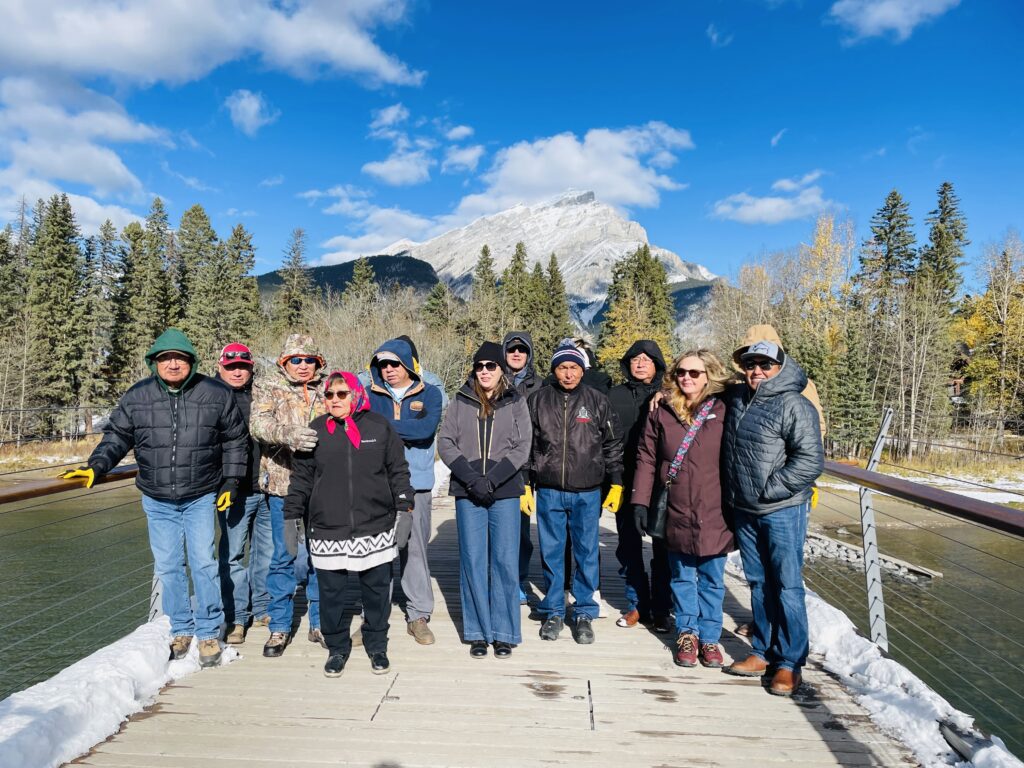
The Blackfoot Confederacy and the Town of Banff gathered today in Natoohsiskoom — the Blackfoot name for the area around Banff, meaning “holy springs” — for a sacred pipe ceremony and offering to commemorate the beginning of a working relationship that will lead to a Memorandum of Understanding (MOU) between the two parties.

The gathering also marked the official naming of the pedestrian bridge in the Town of Banff as the “Thunder Medicine Pipe Bridge”, pronounced in Blackfoot as Ni Naim’skah Ko Yin Ni Mai Pas Tan. The bridge naming has been several years in the making through the collaborative efforts of the Town of Banff, Randall McKay, Manager of Strategic Initiatives and Special Projects, Kirby Smith, and elders and leaders from the Blackfoot Confederacy, including Eldon Weasel Child and Herman Yellow Old Woman of Siksika Nation.

McKay noted that the Thunder Medicine Pipe Bridge, which was completed in 2013, is one of the finest pieces of municipal infrastructure built in Banff over the past 15 years, but until now, had never been assigned a specific name.

Today’s ceremony was attended by Mayor Corrie DiManno — who carries the Blackfoot name Maksikoom Aakii (“Springs Woman”), granted to her by Elder Treffrey Deerfoot at a moving ceremony alongside the late respected Siksika Elder Andrew Bear Robe — and members of Banff Town Council. Leadership from the Blackfoot Confederacy included Chief Travis Plaited Hair, former Chief Roy Fox, Leonard Weasel Traveller, Peter Weasel Moccasin, Elijah Provost, Herman Yellow Old Woman, and Kimmy Shade, CEO of the Blackfoot Confederacy Tribal Council.

In her remarks, Mayor DiManno reflected on the importance of honouring Blackfoot history and knowledge within the lands known as Natoohsiskoom, reaffirming the town’s commitment to a respectful and enduring partnership. Chief Plaited Hair noted that the naming and ceremony represent a continuation of the Blackfoot Confederacy’s responsibility to protect, honour, and renew relationships across its ancestral lands.

The naming of the Thunder Medicine Pipe Bridge stands as a symbolic and living recognition of Blackfoot presence, sovereignty, and stewardship. It marks the beginning of an ongoing partnership between the Blackfoot Confederacy and the Town of Banff that will continue to grow through the forthcoming Memorandum of Understanding — a framework for collaboration in areas of shared interest including land, culture, education, and economic development.

The Blackfoot Confederacy Chiefs have issued a strong statement in response to the Métis Nation of Alberta’s recent efforts to establish Indigenous Protected and Conserved Areas within Blackfoot Territory. The Confederacy says the MNA has not reached out to Chiefs, Blackfoot Nations, or the Tribal Council, choosing instead to issue public statements that fail to address Blackfoot jurisdiction and authority.

The Chiefs emphasize that private land purchases and public contests for naming sites do not override Blackfoot law, stewardship, and ancestral responsibilities that have governed these lands for thousands of years. Any attempts to assert harvesting rights, Aboriginal title, or jurisdiction without Blackfoot consent are unacceptable. The Confederacy condemns actions that bypass Blackfoot protocol as continuing colonial patterns on these lands.

The Blackfoot Confederacy also acknowledged support from First Peoples across Canada and Métis citizens who have publicly stood with Blackfoot leadership. The Chiefs reaffirm that all initiatives within Blackfoot Territory must respect Blackfoot protocol and consent. “Our lands, our laws, our people, our sovereignty—these are not negotiable,” they stated.

The Confederacy remains committed to protecting Blackfoot Territory and upholding the laws and responsibilities that have guided the Blackfoot people since time immemorial.

Read the full release here:

This publication offers a clear account of the Confederacy’s work in governance, advocacy, culture, and community development. It highlights the efforts of a team of Blackfoot professionals dedicated to advancing the collective interests of Niitsitapi and all things Blackfoot.

This first issue covers Quarter 1 and early Quarter 2 (April to August 2025) and features several key developments: the signing of the first-ever memorandum of understanding with the City of Calgary; the Confederacy Chiefs’ May 1 statement rejecting Alberta Bill 54 and reaffirming Blackfoot Treaty sovereignty; continued advocacy in Washington, DC with Alliance Nations to advance Jay Treaty rights and cross-border mobility; the appointment of Kimmy Shade as Chief Executive Officer; and the launch of the Blackfoot Confederacy Guardians of the Eastern Slopes of the Rocky Mountains.

OKI COLLECTIVE is designed to build understanding of the Confederacy’s scope of work, bring clarity to decisions being made, and provide Blackfoot members with reliable updates on progress across governance, advocacy, and Blackfoot-led initiatives.

The Chiefs of the Blackfoot Confederacy have released a statement affirming that the 1877 Blackfoot Treaty recognizes their sovereignty and jurisdiction. These rights are not negotiable and cannot be transferred to outside organizations.

The Chiefs stated that only individual Treaty First Nations have the authority to make decisions on Blackfoot lands. No organization, including the Assembly of First Nations (AFN), may speak or act on behalf of the Blackfoot people without their consent.

Infrastructure projects in Blackfoot Territory must be led by the Blackfoot Confederacy, grounded in their governance systems, and guided by free, prior, and informed consent. The Chiefs said that relying on the AFN to make decisions affecting Blackfoot lands undermines their authority.

The Chiefs also raised concerns about the use of the term “National Interest” as a way to bypass treaty rights and Indigenous laws. They stated that projects impacting their lands, resources, or communities must be reviewed through Blackfoot decision making processes and reflect Blackfoot values.

The Confederacy called on all levels of government to respect the nation to nation relationship, recognize the lands in question, and uphold Indigenous rights, including self determination, language, culture, and traditions.

The Blackfoot Confederacy stated that sovereignty is a lived authority that must be recognized in all government decisions that affect their lands, as is the case for all Treaty Nations from 1 to 11.

Read the full statement below:

The Blackfoot Confederacy is honoured to welcome the Kahnawake Hunters players, coaches, staff, and families—from Kahnawà:ke and the Mohawk Nation to Mohkinstsis (Calgary) for the 2025 Founders Cup.

The national Junior “B” box lacrosse championship runs August 18–24, 2025, at the Seven Chiefs Sportsplex & Chief Jim Starlight Centre on the Tsuut’ina Nation. This event brings together the best teams from across the country, with lacrosse continuing to be a living expression of Indigenous strength and community.

This year holds special meaning for the Blackfoot Confederacy as Zane Chief Moon of the Kainai-Blood Tribe joins the Hunters’ roster. Zane has already made his mark in the lacrosse world—earning RMLL Rookie of the Year (2019) and leading the league in scoring in 2023.

Welcoming the Hunters also carries deeper significance. Both the Blackfoot Confederacy and Kahnawake are members of the Jay Treaty Border Alliance, standing together to protect the rights of Indigenous peoples to freely cross the Medicine Line. In May 2024, the Confederacy attended the Iroquois Caucus General Assembly hosted by the Mohawk Council of Kahnawake, continuing the work of strengthening relationships between our Nations.

As the Hunters compete in Mohkinstsis, we celebrate not only their skill on the floor but also the enduring connections between our peoples. The Blackfoot Confederacy extends best wishes to all players and families during this year’s Founders Cup.

For more information visit founderscup.lacrosse.ca.

Jay Treaty Border Alliance in Washington, DC – June 3–4, 2025

Blackfoot Confederacy joined Tribal Leaders and Representatives from the Jay Treaty Border Alliance are meeting with U.S. Senate and House offices, as well as the Department of Homeland Security, in a two-day fly-in on Capitol Hill to advance cross-border First Nation rights and Jay Treaty advocacy. Strategic sessions include discussions with Senate and House Judiciary staff, Homeland Security officials, and key congressional representatives.

Kimmy Shade and Theoren Royal from Blackfoot Confederacy Tribal Council represented the Blackfoot Confederacy in Washington.

Pictured: Kimmy Shade, Director of Environment & Economic Development for the Blackfoot Confederacy Tribal Council, with Alyssa LaTray, Legislative Assistant to Congresswoman Emily Randall and Amskapi Pikuni descendant, during the Jay Treaty Border Alliance fly-in in Washington, D.C on June 04, 2025.

Both Blackfoot women joined fellow Alliance Nations and Leaders in a united effort to advance Jay Treaty rights, cross-border mobility, and First Nation sovereignty—bringing a strong and unified voice to Capitol Hill.

May be an image of 2 people

Pictured: Kimmy Shade, Director of Environment & Economic Development for the Blackfoot Confederacy Tribal Council, with Alyssa LaTray, Legislative Assistant to Congresswoman Emily Randall and Amskapi Pikuni descendant, during the Jay Treaty Border Alliance fly-in in Washington, D.C on June 04, 2025.

Both Blackfoot women joined fellow Alliance Nations and Leaders in a united effort to advance Jay Treaty rights, cross-border mobility, and First Nation sovereignty—bringing a strong and unified voice to Capitol Hill.